Thursday, August 05, 2010

Longing to Know


This is an excellent book. It does what it says on the tin. I read it at l'Abri, a Christian residential study centre in beautiful rural Hampshire.

It's full of fun stories and illustrations (a marrow that fell off the windowsill into the sink in the middle of the night; downhill skiing; learning to play the piano; the geeky guy in the Matrix who watches the numbers on the screen; and an extended illustration that runs through the book about what it is to know and trust Jeff, the car mechanic). It was written by a philosophy professor at an American seminary who realised that her students had big, personal struggles with epistemology and needed a small, readable book....

It gave me some new hope that we can grow in confidence in our knowledge of stuff, (in general, and in our knowledge of God in particular). Has anybody else read it? Or possibly even better - has anybody else read Michael Polanyi (on whom Meek says she has based much of her thought)? If so, please can you explain to me what the role of Special Revelation is in this model of knowledge? If you haven't read this book, please could you read it and then tell me...

Thursday, January 14, 2010

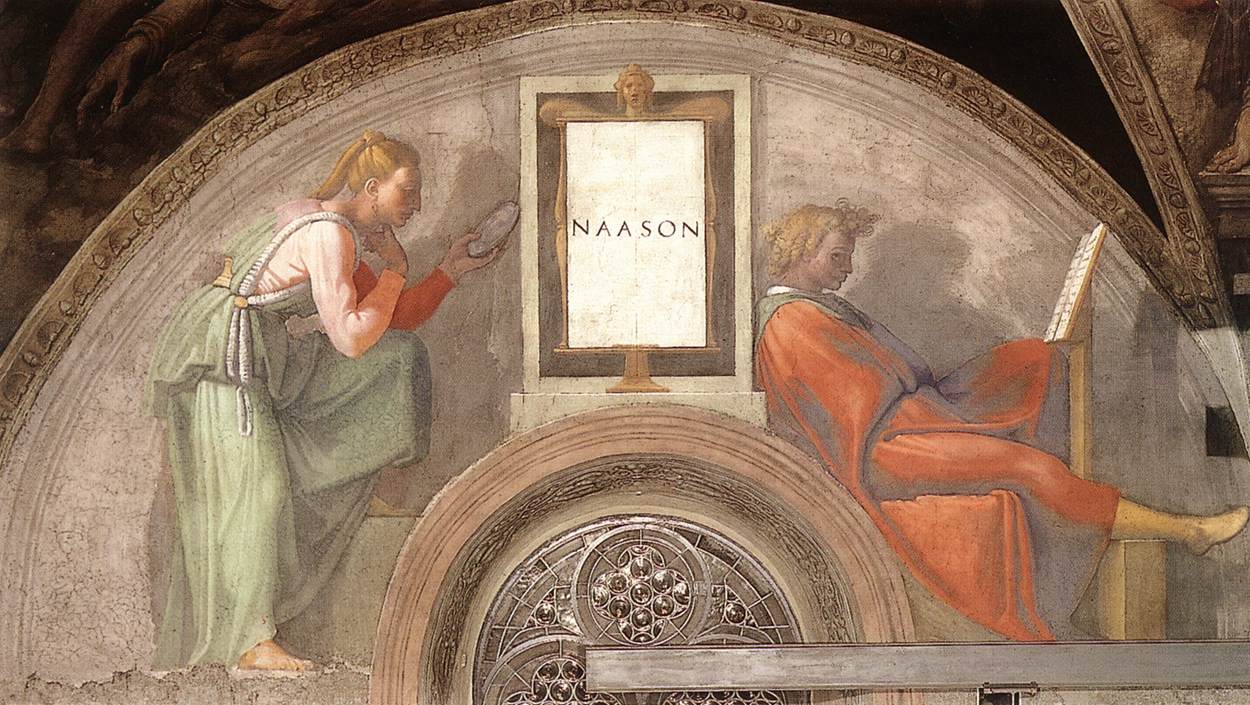
Jesus better than Nahshon.


Inspired by this sermon, my few-and-far-between quiet times since mid-December have been a lot of fun. I've been gradually trawling through the OT, tracing the line of Abraham, Isaac, Jacob, Judah, Perez, Ram, Amminadab, and today Nahshon, to try and understand why Matthew writes his genealogy as he does. Each character is presumably there for a reason, to show how Jesus is the true Son of Abraham and the true Son of David. It's fun, because it's drawing my attention to obscure bits of narrative and genealogy in the early books of the OT that I would normally have no clue what to do with, and it's showing me how amazing Jesus is. I'm still struggling with doubt, and it's a great encouragement to see how the whole testimony of scripture points to Christ.

For example: who knew anything about Nahshon?! Turns out (Numbers 7), that he is the first person to bring an offering to the Tent of Meeting/Tabernacle in the desert of Sinai. Moses and the Levites set the thing up according to God's instructions, and then the leaders of the tribes of Israel bring offerings to dedicate the altar. And the very first to do so is our man Nahshon, from the tribe of Judah. But though God's people are now very numerous, and they are enjoying the blessing of God's presence in the tabernacle, the promises to Abraham still seem a distant prospect. I was thinking about Hebrews 10v1-2 - this offering is the first of thousands to be offered at the earthly tabernacle, none of which will truly deal with sin. If only there were a true Son of Abraham who could fulfil the promises, and make an offering that would bring lasting blessing...

Seems like Matthew knew what he was doing when he included Nahshon then - Nahshon brings the first offering to the earthly tabernacle. His descendant Jesus brings the last offering, to the heavenly tabernacle.

All glory be to thee, Almighty God, our heavenly Father, for that thou, of thy tender mercy, didst give thine only Son Jesus Christ to suffer death upon the Cross for our redemption; who made there (by his one oblation of himself once offered) a full, perfect, and sufficient sacrifice, oblation, and satisfaction, for the sins of the whole world.

Saturday, December 20, 2008

Keep Going by Neil Martin


As promised, here is a brief review. I've no doubt that it is not up to the standards of some of my more literary friends but if I persuade anyone to read it I shall be happy. Neil Martin should really start paying me a commission...

Keep Going is a two-parter. The first is a theology of doubting and struggling. With unmistakeable marks of personal experience, he sensitively yet ruthlessly pulls apart the reasons, good and bad, why Christians often doubt. In all this he works from a soundly biblical perspective and structures his argument in such a way that even the most philosophically-illiterate science student can understand exactly where he's going and how he's getting there.  My experience as I read it was one of self-recognition at every paragraph, followed by the question "yes, but what about..." only to discover that the subsequent paragraph dealt with the arising question. Whether this reflects the fact that Neil Martin is my strange psychic twin or that my experience is more common than I had previously realised, I will leave for you to determine. More seriously, he helpfully navigates the tricky pastoral balance in affirming that doubt is often the product of sin, the world and the devil; that it is a common and in many respects normative experience; and yet that Christian faith can stand up to and indeed be enriched by the use of our God-given reasoning ability to assess the basis of our trust in Christ.

In the second part of the book he addresses some of the most common intellectual struggles that doubters face: the existence of God (helpfully for me, dealing well with the interaction between evolutionary biology and theology); the tension between God's sovereignty and human freedom/responsibility;  the authenticity of the bible; and struggles with assurance. These questions are addressed within the framework established in the first part of the book, and as such provide excellent case studies of how to think biblically about difficult questions. Having said that, I think most doubters would feel that if they settled the existence of a sovereign, loving, and just God; the reliability of the biblical testimony; and were certain of a place kept for them with God for eternity and of their adoption as sons by the blood of Christ, they really wouldn't need to work out that many other doubts... I'm not saying Martin's book quite gets you there, but it's definitely a sizeable shove in the right direction.

Here seems as good a place as any to repeat the request for your help and input on this blog: Martin often led me to conviction of the sin of using half-thought-out objections as an excuse not to trust Christ. So as I write of some of my struggles, please flag up where they are poorly-thought-out, and send me packing back in the direction of the cross! One memorable passage from Keep Going has been this one:

With the bible too, research can only take us so far. It can help us reach the point where we're intrigued and persuaded by the bible's relevance - but it's only in actually doing what it says that our confidence will really be established. And this is just as well because if confidence really did depend on our grasp of the historical evidence for the New Testament - or any other form of external evidence for that matter - faith would be restricted to the educated. But as God has arranged things it's just one of the many means available to help get us to the start - and persist through the difficulties - of the Christian race. It can bring us to the point where we're ready to give Jesus a hearing, but it's what we do with this readiness that determines whether or not we'll grow in confidence that the bible is really a revelation from God.  (p128)

It's been a while


This blog didn't really get that far off the ground, did it? I'm now a fourth year medic, still a member of St Ebbe's church in Oxford, still thinking through issues of faith and doubt and trying to live for Jesus. This term has been a good one - medicine has been exciting and I've learnt lots of different things. Living with an English graduate has been a useful spur to me to do a bit more reading, which twinned with the hardy perennial of good chats with faithful Christian friends, has been of great help to me in my faith. I'm now on Christmas holiday and thought I might do some writing here over the next few weeks to help me crystallise some recent thoughts and bring the record up to date! Even this evening as I've re-read previous posts I've been struck that some of the "new lessons" I thought I'd learnt this term aren't actually new lessons at all, but rather rememberings of lessons that I knew two years ago.

In the next couple of weeks I'd like to write a bit more about the nature and basis for faith, some thoughts on the dreaded Quiet Time, as well as some book reviews of Spiritual Depression by Martin Lloyd Jones, Tested by Fire by John Piper, and depending on how far I get, perhaps the rather contrasting works of House of God by Samuel Shem, and (if I've read it) Orthodoxy by G.K. Chesterton. But to kick off this evening (and procrastinate getting on with wrapping my Christmas presents...) a review of a book that I first read over a year ago, and which has been frequently referred to and recommended to friends since. I think it is (apart from the bible) the single most helpful book I have ever come across. If there is anyone out there reading this blog who is currently actually struggling with doubt, stop reading this blog, and start reading this book...

Wednesday, January 24, 2007

It'll be a day like this one....


Is this the new year of just another night
Is this a new fear or just another fright
Is this a new tear or just another desperation
Is this the finger or just another fist
Is this the kingdom or just a hit and miss
I miss direction most in all this desperation
Is this what they call freedom
Is this what you call pain
Is this what they call discontented fame

It'll be a day like this one when the sky falls down
And the hungry and poor and deserted are found
Are you discontented? Have you been pushing hard?
Have you been throwing down this broken house of cards?
It'll be a day like this one when the world caves in.

Switchfoot - The Blues.


It'll be a day like this one. When I'm really not certain of very much any more. But Rosemary and Laura independently pointed out to me in the last few months, you can never prove the things you most want to be certain of. Even in maths, apparently, it's proven that in any axiomatic system you can never prove your axioms. We make decisions without being certain every day. As Becky put it - you check whether you're getting onto the right bus, but you don't check whether the bus has enough petrol. As Victoria pointed out - you choose an Oxford College even though you can't really compare them before you've studied at one. And yes, the more important the decision, the longer you think. I'm not certain. But everything in me is longing for the day when the world caves in and when I see my Lord and Saviour face to face. When he is worshipped and glorified as he deserves, when we will be together from every tribe and nation and language. And the promise is that it will be a day like this one, and I want to be ready.

Wednesday, October 04, 2006

Narrativium and Occam's razor

One thing which keeps me trusting in the gospel is that Christianity has huge explanatory scope - it really does make sense of life. Every aspect of human experience seems to me to be well-explained by conservative biblical theology, and those aspects which cause problems (eg - predestination-free will) are sufficiently addressed in the bible to the extent where I would be able to trust the God who knows the answers that we don't know. I'm just a little bit confused as to whether this is a good reason to trust.

The post-modern says "Christianity is a crutch, it makes you feel significant, it's a fictional metanarrative that means that you're not just a random collection of atoms" and in some ways there's a lot of truth in that. Christianity does make sense of life - the writer of Ecclesiastes says that God has set eternity in the heart of man, and all of us long for meaning and purpose. Of course, the Dawkins-ish atheist point of view is that this is just an artefact of being human - looking for the big picture in a situation is what makes us intelligent, sentient, but we also tend to find big pictures where there are none. Terry Pratchett of all people puts this point of view across very eloquently in his book Discworld Science. He explains that Discworld runs on narrativium, that is, stories, but as the scientists of the Discworld Unseen University inspect our universe they are horrified to realise that there is not a trace of narrativium in the universe they've made. Anyway... that's a bit of a pointless aside.

Amy Orr-Ewing (bethinking again), who works for the Zacharias Trust, which produces high quality apologetics materials/speakers/training, says that she believes Christianity to be true because it is both "intellectually robust and existentially satisfying". Intellectually robust - well, I'm working on it. Freshers' week provided lots of opportunities to talk to non-Christians about Christianity and it has to be said that by God's grace as I was giving the defences of Christianity that I've been reading over the past few weeks, they did seem reasonably compelling... But I'm still a bit stuck with the assumptions-conclusions step outlined before. Existentially satisfying - yes, yes, yes. Everything in me longs for a Father God, who will uphold justice and righteousness whilst extending mercy, and promise me a future where there will be no more sin, sickness, injustice, pain or death. I'm terrible at following him, I reject him and belittle him in my actions and thoughts every day, but when push comes to shove it's such a privilege to be able to run back to him and know that there is forgiveness.

I guess with term starting I've had less time to think and read in depth, though I'm enjoying studying the gospel accounts (more on that another day), but one thing I have been able to do is to put my faith into practice in evangelism and in the general circuit of Christian meetings that is OICCU/Ebbes student life. And it makes sense. It fits with most things anyway. So I guess the question is what Phil was getting at in his comment - do you trust because the impossible option just rings true? Is this an ideal opportunity to use Occam's razor and say "Jesus resurrection is the simplest answer, therefore it's the best answer". I guess it depends what the objections are, and how serious they are... I'm not quite sure what the objections are, other than "it's impossible!" so I think that's where this blog is headed next. Are there serious objections?

Tuesday, September 26, 2006

Taking the bull by the horns.

Ok then, enough skirting round the issue. So dead men don't rise, right? Men who have been physically and psychological tortured and then killed by expert Roman executioners, laid in a tomb for two days with a Roman guard and a heavy stone across the entrance, and whose followers are a disheartened bunch of Galilean fishermen scared and pretty much ready to pack it in because their hopes for a political Messiah who would get shot of the Romans don't seem to have gone so well, do not generally leave the tomb, appear to their followers and spawn the world's largest religion. Except when they do. Thus (or words to that effect) goes the commonly given and reasonably compelling argument for what one of my classicist friends described today as "the best attested historical event in ancient history".

That account takes details from the gospel narratives (burial in Joseph of Arimathea's tomb, the Roman guard, the stone, the mood of the disciples) as coming from reliable contemporary historical sources. Now I'm no NT scholar, but it seems to me that the scholarly approach to the gospels is often dictated by preconceptions about whether Jesus is God. The one that's jumped out at me is the dating of Mark's gospel - often put by liberal scholars after AD 70 because it predicts the destruction of the temple. Fair enough, if Jesus wasn't God and didn't rise. However when you're trying to find out whether Jesus rose this is plain irritating. Talking to the above-mentioned classicist friend he was expressing frustration that the texts are treated differently by historians, theologians, classicists and NT scholars. All of which makes it very very difficult as a lay-person to wade through and figure out what the evidence really is. The best solution seems to be "assume very little, work on the basis that the gospels aren't reliable, and see where you end up".

So the next questions on the resurrection go along these lines:
1) What are the bits of evidence that no one can dispute
2) What are the possible explanations for those events

Now assuming one fights through that bit (not yet achieved on my part), this brings us to the next problem which is given different explanations, how do you assess them to arrive at your conclusion. I've spent a lot of time over the last few days reading different viewpoints on the resurrection, and there seem to be a couple of more rambling methodological questions

3) Does it matter which perspective you start from? Can you have a null hypothesis? If so, what is it? What happens if you can't reject either hypothesis? Mark W suggested starting by assuming the resurrection, since all other theories are a reaction to that original theory, which seems reasonable. Most arguments between Christians and atheists on the resurrection seem to get to an impasse because the atheist can't prove the non-existence of God and complains that this is attempting to prove a negative result and therefore impossible - a similar thing might happen with trying to prove that a historical event didn't occur. I'm not sure.... The problem is that people don't write historical documents entitled "a long list of things that didn't happen today, just so as we're quite clear 2000 years from now" and even if they did it would not be likely to be comprehensive!
4) How do you go about assessing the plausibility of a supernatural explanation? At least one liberal scholar suggests that Jesus had a long-lost identical twin brother who appeared after his death and fooled the disciples that he was the Risen Christ, in an effort to avoid a supernatural explanation for the resurrection appearances (though not the empty tomb). It certainly seems farfetched, but so does an infinite creator God who cares about tiny rebellious humans, to be perfectly frank. The muslims go to the opposite extreme - they prefer the idea of Allah mystically changing the appearance of someone else to look like Jesus being crucified so as to avoid the conclusion of a resurrected Son of God. Makes perfect sense, if Allah is One God and has no Son. Of course it's more plausible.... This is that irritating "working from your conclusions backwards" thing again. I really hope I've missed something in the above two points or the whole-Christian-faith-hinging-on-the-resurrection is going to get very frustrating very fast.

I'm still thinking about this stuff and have appointments to grill people who know about these things... more stuff on the resurrection soon... For tonight, I admit that I don't know, that my puny little nearly-second-year-medic knowledge and experience is not up to ploughing through all this stuff. For now I rejoice to confess with generations of Christians since the earliest church: "Christ is Risen. He is risen indeed. Hallelujah!" and to trust that God saved me by his own power and will keep me by his own power and for his own name's sake.

[For those who have boundless time and energy, a lot of these ideas are garnered from a debate between William Lane Craig (prominent Christian scholar and apologist) and Bart D. Erhman (interesting if wading through heated debates is your thing). I also came across interesting comments on the debate in this blog, where some conservative Catholics discuss the issues.]

Friday, September 22, 2006

A short aside on the nature of faith.

I think I'll start with question 3 for the purposes of knowing what we're aiming for - how good does the evidence have to be before the resurrection is credible, and what is the role of religious faith in all this. I'd better nail my theological colours to the mast - I think the bible is pretty clear that we contribute nothing to our salvation except our sin, and that faith is a gift of God. This has been troubling me over recent weeks along the lines of "if faith is a gift of God, and as a Christian I've received it, why am I not 100% persuaded of the truth of Christianity at all times". Thankfully, a fascinating talk from the bethinking website by Bruce Little, some good thinking and some thrashing things out with Helen this evening has exposed the flaw in my argument. So - hot off the press, what is faith, and how does it relate to the evidence. Again - not a new idea... However, because it's something that I've finally got straight, I think I'll quote Bruce Little's talk from bethinking:

“Now faith is the substance of things hoped for, the evidence of things not seen” (Heb. 11:1)

...The verse is clear that faith is about what is not seen, and not about what is unknown. It could be said that faith is not an epistemological word, which is to say that we do not acquire new knowledge through faith. Instead, faith is a response to what is revealed.

Which basically goes to say that faith is not about becoming persuaded of the truth of the resurrection by some mysterious leap into the dark, but rather about acting on the evidence. So in the here and now - we can't see God, and we certainly can't see the promise of heaven. Faith is the action of believing the evidence and putting your trust in God and waiting for heaven. This definition rings true if you're a Christian who's been in debate with a non-Christian who has been seeking God for a while - it is quite possible to answer their every objection, to explain the gospel for the umpteenth time and to be met with a response of "Yeah. It makes sense, it's just not for me." or "Perfectly honestly - I kind of agree with what you're saying, but I know if I became a Christian I'd have to stop sleeping with my boyfriend". Which if you're the Christian in that situation is about the most exasperating evangelistic experience it's possible to have - and it drives you back to prayer that God would give the gift of faith - not just to give intellectual assent to an argument, but that they would put their whole weight and trust on Christ. The bible is quite clear that left to ourselves we will reject Christianity 10 times out of 10 - but not for want of evidence, but out of our innate rebellion against God and what is good. We are blind to the truth and dead in our sins until God gives us the gift of faith by his Holy Spirit.

But - none of this goes to say that the evidence for Christianity is in some way lacking, and must be made up for by "a leap of faith". Which is nice, at least if you're a question-asking type of person like me. From a Christian point of view - this is also reassuring because it means that one can have the "gift of faith" - ie what it takes to act on the truth of the gospel in terms of changed life, whilst also going back and looking critically at the evidence. This is nice - it reassures me that I'm not a raving heretic/apostate/backslider :) (Well, I probably am on other counts, but not on this one at least).

Which leaves us with looking at what Bruce Little terms "The Justification for Faith". That is - this whole aside was a bit of a red herring... Ah well. We live and learn.

Tuesday, September 19, 2006

The Anchor - Jesus' Resurrection

Right then. May as well start with the foundations...

Paul puts the importance of the resurrection quite clearly in 1 Corinthians 15.

And if Christ has not been raised, then our preaching is in vain and your faith is in vain.

Anyone who's done the rounds of apologetics talks or has thoughtfully considered the Christian faith to any degree will have already encountered this idea, it's hardly new. Essentially, the gospel accounts make claims that Jesus is the Son of God - the start of Mark's gospel is a good example. These claims stand or fall on whether he was raised. If Jesus was raised from death, then we can have a reasonable degree of tolerance for loose ends in obscure bits of old testament narrative or thorny philosophical debates about free will and predestination because we know that our confidence is in the God who raised Jesus from the dead. The achievement of the resurrection is put across in 1 Peter 1v3-4

Blessed be the God and Father of our Lord Jesus Christ! According to his great mercy, he has caused us to be born again to a living hope through the resurrection of Jesus Christ from the dead, to an inheritance that is imperishable, undefiled, and unfading, kept in heaven for you.

So the certainty of having been born again, and having a future in heaven rests on the resurrection - elsewhere Jesus' resurrection is described as the first-fruits, and after our death we will be raised at the final harvest. I went to a funeral yesterday where it was hard to be sure what the teenager whose life we were remembering had believed about Jesus. His destiny and ours rest on two things - the facts, and our response to them. This is no trivial question.

It seems to me there are a couple of questions to be asked about the resurrection.
1) Can we know for certain whether or not Christ has been raised.
2) Can we know with sufficient confidence to merit putting our trust in his death and resurrection or rejecting it outright.
3) What is the role of the supernatural gift of faith that enables us to trust - is faith a persuasion in spite of the evidence? in the light of insufficient evidence? or a putting of firm, active trust in something which we are already convinced of?

To be continued...

A creative tension - why the blog?

I do not want this blog to be about me. It's going to be about the bible, and the evidence for Christianity, and the interplay between faith, evidence, doubt, trust, sin, and thorny issues we'd rather pretend didn't exist (young earth creationism, anyone?). But so that you know where it's coming from... here's the raison d'etre.

1) Christianity is not an abstract set of ideas with no foundation in the observable, testable realms of history and science. It is about a relationship with a God who entered human history. This means (thankfully) that doubters do not have to be told to shut up and go away, lest the whole edifice come crumbling down around everyone's ears. God is not afraid of being "found out". At least in principle, healthy scepticism can be just that and the church is stronger for facing up to and answering criticism and intellectual debate. The whole western approach to scientific study was fostered in the Christian worldview that said "the world is a rational place, created by a God of order, and it's a good thing to ask questions and find out about it".

2) As a Christian I have come to believe that there is no proverbial fence to sit on. There is no such thing as the dispassionate observer when it comes to matters of heaven and hell, life and death. After years of struggling in my faith and having been unable to come up with a disproof of the Christian message it seems that the best course of action is to put my trust wholly in my creator God. This is summed up well in Isaiah 29 and 30 where there is -

- an explanation of the absurdity of doubting God's existence:

You turn things upside down, as if the potter were thought to be like the clay!
Shall what is formed say to him who formed it, "He did not make me"?
Can the pot say of the potter, "He knows nothing"?


- a dire warning of the consequences of rejecting the truth of the gospel:

Because you have rejected this message, relied on oppression, and depended on deceit, this sin will become for you like a high wall, cracked and bulging that collapses suddenly, in an instant.

- and an amazing promise

In repentance and rest is your salvation,
in quietness and trust is your strength,
but you would have none of it....
... Yet the Lord longs to be gracious to you;
he rises to show you compassion,
For the Lord is a God of justice,
Blessed are all who wait for him.


So God willing, this blog will attempt to work through some doubts and questions, but prayerfully, reverently, in the spirit of Deuteronomy 29:29

The secret things belong to the Lord our God, but the things revealed belong to us and to our children for ever, that we may follow all the words of this law.

To finish, a note to kind readers.

Firstly - little of this blog will be original - much credit should go to good friends like Helen R, Mark W, Phil B, Vicky B, Jud P and many others who kindly thrash things out with me. Many of the thoughts not nicked from Christian friends will have come from the UCCF bethinking website, and authors of such books as F.F. Bruce's "Are the NT documents reliable?" or Strobel's "Case for Christ". I'll try to attribute things as I go along, but I'm not always great at remembering who said what...

Secondly - I would value the help of my brothers and sisters in bringing me up short if this blog degenerates into tedious or unhelpful introspection or self-pity, or if you think I'm not getting the tension right in reverence/questioning. Also, any thoughts on topics addressed are gratefully received. I am eternally grateful for good friends who have personified both aspects of the command in the letter of Jude:

Be merciful to those who doubt; snatch others from the fire and save them; to others show mercy, mixed with fear—hating even the clothing stained by corrupted flesh.